This was Edition 01 · 25 June 2026
AI for Pune leaders.
Straight talk on AI and where it actually earns its place in your business. In plain English, no code, no jargon.
A room for people building organisations that shape how we live and work, because we believe business can be a force for good. Convened by Aditya Jhunjhunwala · Let's Enterprise.
WhatIn Good Company · a recurring room for leaders. Edition 01: AI.
WhenThursday, 25 June 2026 · Bhosalenagar, Pune
Led byMoumita Sarker · Illuminati Consulting
Why this room
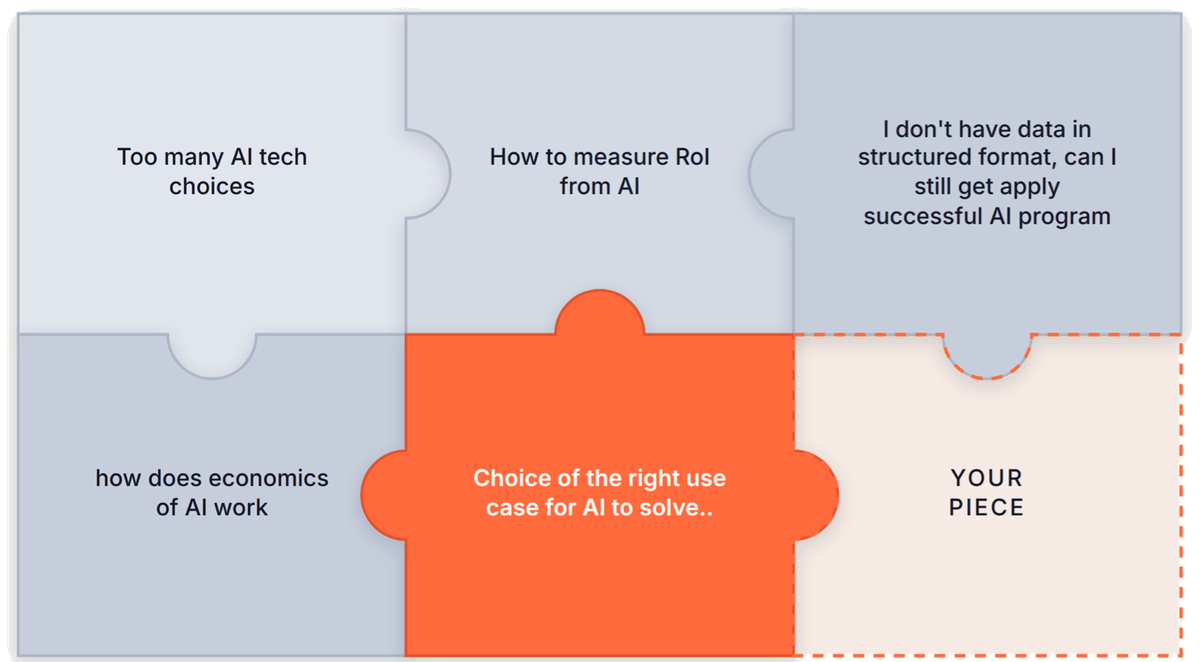
The pieces every leader is holding
What to expect
Built for blunt questions, not slides
01We've solved these pieces before
Real production use cases from businesses your size, not big-tech vanity projects.
0222 years, customised for you
Where GenAI, traditional ML and agentic AI each fit, in plain English.
03Practical, not theoretical
Prototypes, and the honest success & failure points of the AI journey.
We'll cover use cases across the value chain.
Planning›
Operations›
Supply Chain›
Sales & Distribution›
HR & Finance›
Customer Service
Who's leading it
MS
Moumita Sarker
Founder & CEO, Illuminati Consulting · LinkedIn ↗
One of India's most senior AI leaders. Built Deloitte India's Agentic AI Centre of Excellence for South Asia (Partner); co-founded Cartesian Consulting; founding member of HDFC Bank's analytics team. 20+ years getting AI past the pilot stage and into real P&L, across BFSI, FMCG, QSR, retail and hospitality.
AJ
Aditya Jhunjhunwala
Your host · Founder, Let's Enterprise · LinkedIn ↗
I work with leaders as a thinking partner, helping them build the next generation of organisation, the kind ready for the human and technological shifts already underway. Underneath that is a bigger belief about education: that people learn best by doing real work, in good company. Let's Enterprise is where I put that to the test, building India's first working BBA, where young people learn inside real businesses instead of lecture halls.
I won't pretend I have AI figured out. That's why I asked Moumita to lead this, and pulled together a small room of leaders I respect. My job on Thursday is to hold the room, and connect you to each other after.
The room
Leaders joining you
A curated room across very different industries. The cross-pollination is half the value. A few seats are still being confirmed.
The session · 25 June 2026
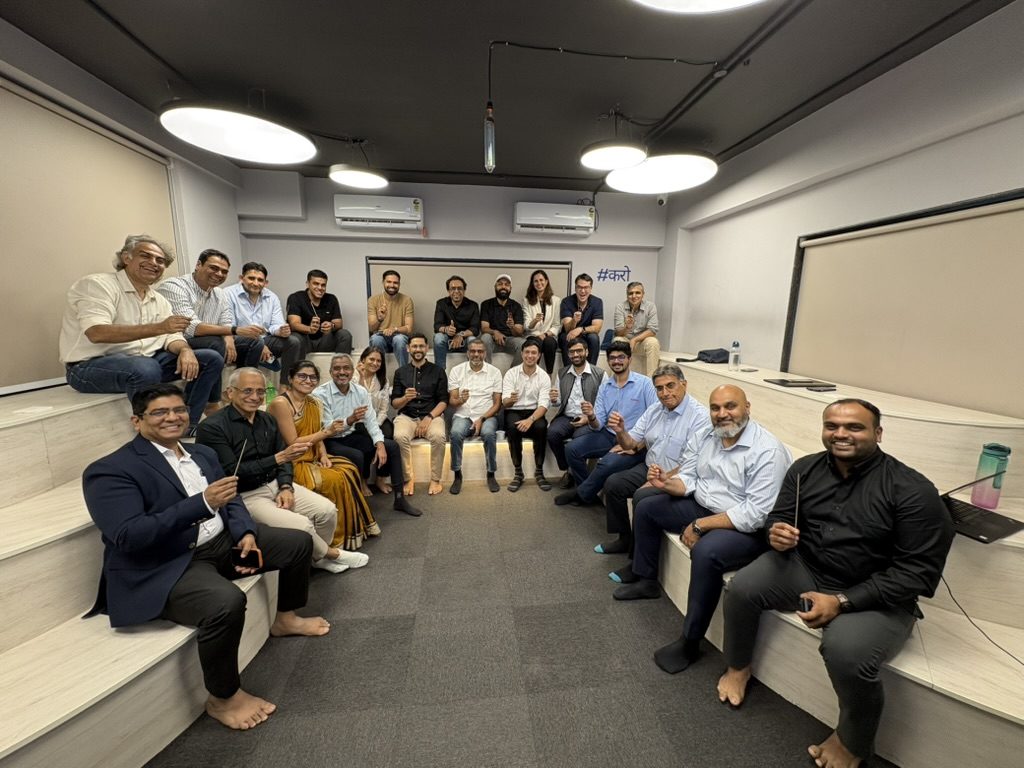
What we covered, in good company
Edition 01 · a room across manufacturing, FMCG, real estate, healthcare, mobility and pharma.
MS
Led by Moumita SarkerIlluminati Consulting · 21+ years across BFSI, FMCG, QSR, retail & hospitality · ex-Deloitte (Agentic AI, South Asia)
The opening · a wand
Imagine AI is a wand
✦ It can do almost anything you ask
✕ except make someone fall in love
✕ and move money on its own
The question to the room
"If I gave you this wand today, and we met again in a year, who would have built the most wealth?"
The answers came fast: audacity, disruption, hunger. All true. But there's a sharper turn.
The turn
If the wand does anything you ask, the only thing separating us is what we ask for. The courage and imagination to ask. That is deeply human. So the paradox: as technology gets more powerful, our humanness matters more, not less.
The IKEA cup
An IKEA worker once gestured for me to carry my own coffee cup to the bin, rather than clearing it herself, because IKEA had trained her to. A small act that quietly disrupted a deep culture code about who cleans up after whom.
A business's impact is not only profit. It is the behaviour it normalises: subtle, powerful, often irreversible. Business can be a force for good.
What In Good Company is for
To sharpen our humanness even more, as we move boldly forward.
AI is not one thing you "adopt." It is a toolbox. The job of a leader is to know where to use what, pick your core processes, design on paper first, and ship a real prototype in six weeks, not a six-month science project.
The map
Know where to use what
AI is a superset of techniques, not a single tool. Four layers, plus an agentic wrapper. Tap any layer for a real example from the room.
Descriptive & DiagnosticPlain statistics · no AI needed
- Descriptive is your dashboards and KPIs, what happened.
- Diagnostic asks "why is this region down?", broken into factors.
Example: "Which SKU is doing well and which isn't" is statistics, it's already in your data. No LLM required.
Predictive & PrescriptiveClassical ML & forecasting
- Predictive looks ahead: sales, revenue, cash-flow forecasts.
- Prescriptive suggests the next action, like a recommendation engine.
Example: the pizza counter nudging "add a free garlic bread" is a prescription, the same logic as a Netflix recommendation. A sales forecast uses forecasting techniques, not generative AI.
Computer Vision & Deep LearningReading images and documents
- Reads pictures and scans: share-of-shelf, damage detection, handwriting.
- Needs to be taught first, show it a Maggi pack before it can spot one.
Example: a camera calculating how much shelf a brand occupies; or reading "tomato" off a messy vendor invoice and pulling the PO number and price.
Generative AICreate something new, without your data
- The first technique that doesn't always need your own data to work.
- Generates new text, drafts, summaries from a prompt.
Example: writing a vendor email that pulls a few components from your reports and sends it out.
The wrapper · Agentic AI
Agentic AI doesn't replace the four layers, it orchestrates them. It stitches small pieces you already have into a workflow and adds a layer of human-like reasoning and checks. Like a junior analyst who takes your report, adds the forecast, checks the numbers, and flags what looks off. "Agents at work," each with a goal, handing off to the next.
"You don't need a gun to kill a mosquito." Some things are still best solved in Excel.
The playbook · tap to expand
Ten things worth taking back
1Go bold with the core, not the periphery
- Take five core processes; choose two for the year.
- Reimagine finance, manufacturing or sales, not an investor-report generator. That's "only X."
2Don't throw away what you have
- Old bots, dashboards and legacy systems are pillars you stitch together.
- Build agents around SAP rather than rebuilding it. Add a box; don't discard boxes one and two to build box five.
3Prototype in six weeks
- On your own real data, never sample or AI-generated data, and fully integrated.
- Do it for one small region, but include the integrations. A toy in a box that isn't wired in will not work.
4Design on paper first
- If you can't draw the process and mark where humans approve and agents act, you can't build it.
- Only when the paper design is signed off does the build start.
5Choose on AI economics
- Run a 2x2 where one axis is whether it makes economic sense, not just data availability.
- Direct value, indirect value and cost decide the final two out of five.
6Tame token cost with a router
- Simple, known questions answer from existing dashboards (cheap and deterministic); only genuine reasoning hits an LLM.
- One bank let everyone "just query" with an LLM and shut it down within three months on cost.
7Format and silos no longer matter
- Dump Excel, PDF, even legacy design IP as-is; agents will read it.
- But only if you give them the knowledge base. They are not magic; you still have to teach them.
8Humans and agents on one screen
- Build the human-in-the-loop in, with confidence scores and tolerances ("below 98%, notify a human").
- Don't run a parallel human system alongside the agents.
9Visibility is non-negotiable
- Show every step: what was extracted, what's pending, where the exceptions are.
- Done right, it's more transparent than a human team, not a black box.
10Go modular
- Break a big program into 8-week sprints that each stand alone but add up to one number.
- Britannia's field-only intervention drove roughly 4% incremental top line, without tackling all four sales problems at once.
The questions · tap to open
Moumita on the room's hardest questions
Drawn from the room's own submissions and the questions asked out loud. Not conclusions, prompts to keep thinking about.
?Where does AI actually earn its place in my business?The most common question in the room
- Start with the core, not the periphery. The investor-report bot is safe and small; reimagining a core function is where value lives.
- Of five candidate processes, only the two where value clearly beats cost are worth doing this year.
- What would you attempt if the build took six weeks, not six months?
?How do I make AI a real competitive moat, and measure it?Advantage, not just efficiency
- The moat isn't the model everyone can rent; it's your data, your processes, your "AI assets" already hiding in your people and tech.
- Tie each initiative to one number (a Britannia field programme moved ~4% of top line). If you can't name the number, is it a moat or a demo?
- Value shows up as direct, indirect, and cost avoided. Which of the three are you actually banking?
?How much of the work can it really replace?Trading, engineering, radiology, the field
- It swings wildly by use case: ~30-40% in regulated RBI reporting (sign-offs stay human), ~80-85% in a field-sales flow, except the human conversation itself.
- The design part of architecture or a tyre's legacy IP can be largely automated; the final judgement call rarely is.
- The honest question isn't "what can it replace" but "where do I still want a human deciding?"
?How do I keep AI under control and govern it?An invoice to a customer, the wrong tax code
- Governance is neither an afterthought nor a gate you wait behind; build it in from the first design.
- Give every agent a confidence score and a tolerance, e.g. below 98% on a customer-facing invoice, it notifies a human rather than acting.
- Keep humans and agents on the same screen, not two parallel systems. Visibility into every step is the real control.
?Won't the cost (tokens) balloon? How do I put rails on it?A bank's "let everyone query" mistake
- One bank opened LLM querying to everyone and shut it within three months on cost. The fix is design, not a ban.
- Use a router: simple, known questions answer from existing dashboards (cheap); only genuine reasoning hits an LLM.
- If you design it well, you can estimate token cost up front. If you can't estimate it, you haven't designed it yet.
?Is my data structured enough? What about privacy?Silos, formats, confidentiality
- Format and silos matter far less than they used to. Dump Excel, PDF, even flowcharts as-is; agents read them.
- But give them the knowledge base, they aren't magic and won't know your context unless taught.
- Privacy is a design constraint, not a blocker: decide up front what stays in-house, what an agent may see, and where the human sits.
?People vs AI: does it over-promote the wrong people?Talent, dependence, the human edge
- Yes, it's a real risk: someone aided by AI can look as sharp as a natural thinker. The defence is awareness at the manager level.
- Ask for a whiteboard or paper design first; you can usually tell genuine thinking from copy-paste.
- By the 11th iteration, AI tends to mirror your own thinking back. The original thinker still pulls ahead, the pure tool-user plateaus.
?From pilot to production: how do we actually move?Experiments into execution, upskilling teams
- Prototype in six weeks on your own real data, fully integrated, even if only for one small region.
- Don't endlessly experiment. A small, real prototype that people use beats a perfect plan no one feels.
- Train in personas: leaders, functional managers (who must bring a real cost-benefit sheet), and tech teams.
?How does this plug into the systems we already run?Third-party apps, Tally, "no MCP"
- You don't need every system to be "AI-ready." Build your agents as boxes outside a vendor's locked product and call in via API.
- Agents talk to systems through plain APIs, and MCP where it exists. No MCP (e.g. Tally)? A simple file drop-off works.
- Don't pay a vendor to unlock what you can build alongside it and integrate.
The thread running through all of it: choose the core use case, design it on paper, prototype in six weeks, and keep a human on the same screen.
Shared with the room of In Good Company · Edition 01. Different industries, the same questions.
Get my weekly letter
Eat. Play. Love. One honest note a week on building a life, and a body of work.
Please enter a valid email.
You're in.
A letter lands in your inbox each week.